How to Use Global Fraud Index to Spot Fraud Trends Before They Hit Your Industry
In the cat-and-mouse game of cybersecurity, the “mouse” usually has a head start. By the time a new phishing narrative or payment scam hits the mainstream news cycle, the peak of the attack has often already passed. For compliance officers, risk researchers, and business leaders, relying on news headlines is like trying to navigate a ship by looking at the wake behind it.
To stay ahead, you need a lead indicator. This is where Civoryx, the Global Fraud Index, comes into play.
Civoryx is a public, data-driven platform designed to track how fraud attention shifts across the internet in real-time. By monitoring the “Scam Trend Score,” professionals can identify which specific threats are gaining velocity globally before those threats manifest as a spike in their own company’s support tickets or loss prevention reports.
This guide will walk you through how to interpret Civoryx data, use its unique scoring system to prioritize threats, and integrate these insights into your industry-specific defense strategy.
What is Civoryx? The Mechanics of the Scam Trend Score
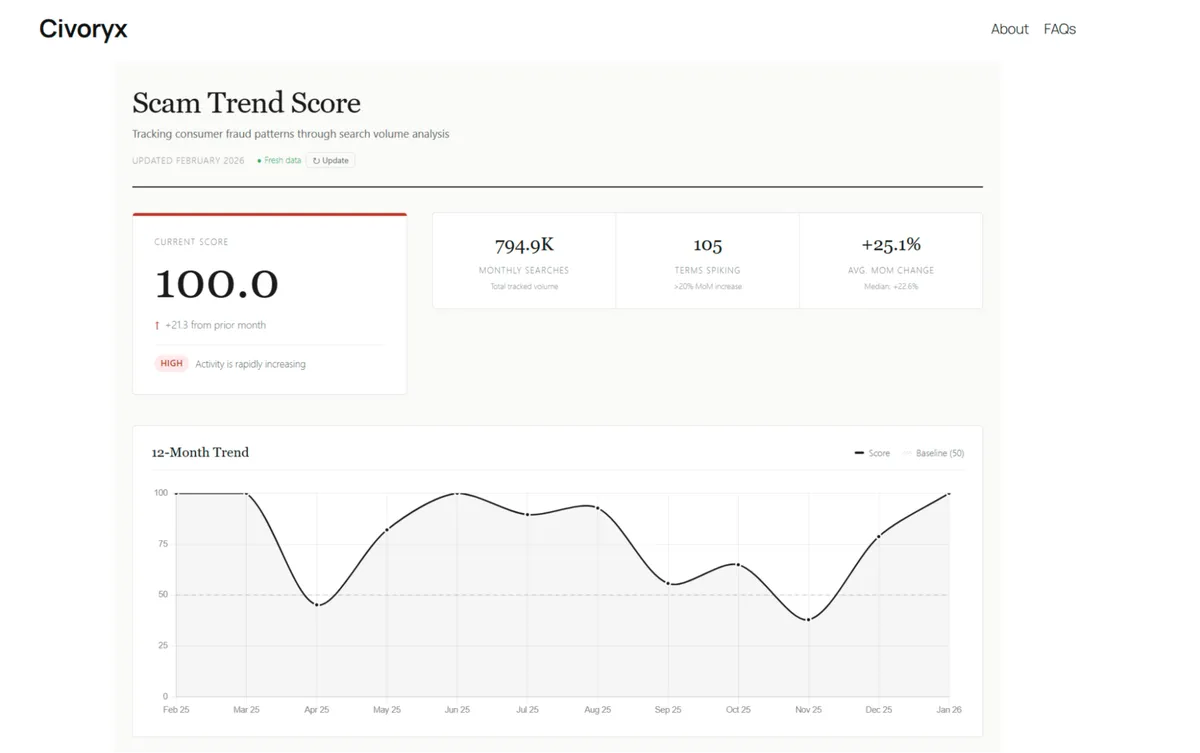
Civoryx was built on a simple premise: Fraud evolves faster than headlines. To capture this evolution, the index moves away from “expert opinions” and focuses entirely on raw search data.
The Three-Layer Methodology
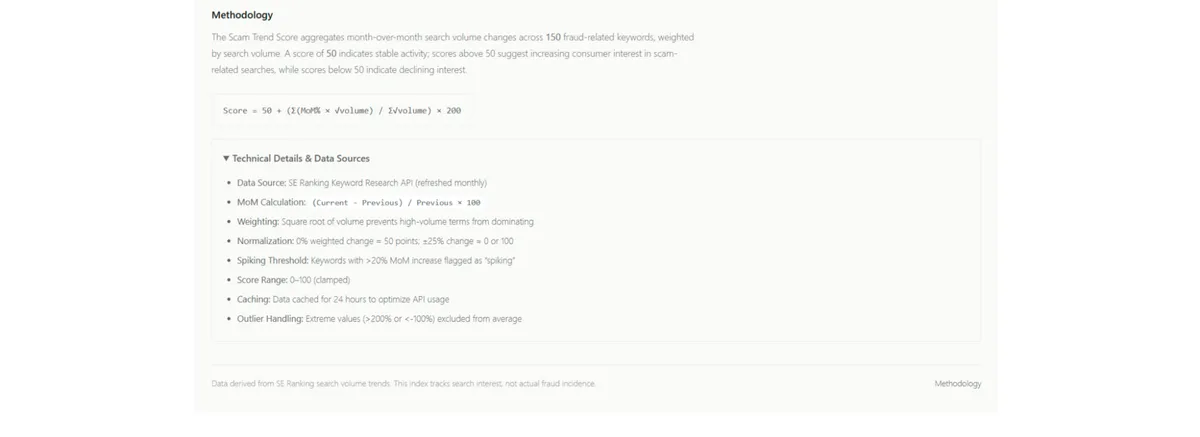
Civoryx produces a single, transparent signal known as the Scam Trend Score. This score is derived through a three-step process:
- Monitor: The system continuously tracks search volume for a curated index of over 150 fraud-related keywords. These span categories like phishing, identity theft, crypto scams, romance fraud, and more.
- Measure: It calculates the month-over-month (MoM) velocity for each keyword.
- Score: The changes are weighted by absolute search volume. This is a critical distinction; a 500% spike in a niche term with only 10 searches doesn’t move the needle as much as a 10% spike in a high-volume term like “credit card fraud.”
The result is a composite metric. A rising score indicates that fraud-related interest is accelerating globally, while a falling score suggests a period of relative cooling or a shift in tactics.
How to Use Global Fraud Index?
Lets discuss.
Step 1: Identifying the “High-Signal” Drivers
When you first look at the Civoryx index, your goal shouldn’t be to look at every keyword. Instead, you want to identify the concentrated signal.
In any given month, a small cluster of themes usually drives the majority of the index’s movement. For example, recent Civoryx data shows a massive concentration in seasonal financial fraud and impersonation.
By looking at the “weighted impact” or “contribution score,” you can see which specific scams are currently dominating public attention. Current data highlights these heavy hitters:
- Tax fraud: 75.74 contribution
- EZ Pass scams: 57.94 contribution
- Credit card fraud: 21.36 contribution
- Coinbase text scam: 12.43 contribution
- PayPal scam email: 10.53 contribution
The Strategy: If you work in fintech or government services, the high contribution of “tax fraud” and “Coinbase” scams tells you exactly where the “heat” is. You should be auditing your SMS templates and customer alerts for these specific keywords immediately.
Step 2: Analyzing Velocity vs. Volume
While the weighted contribution tells you what is currently big, the Growth Percentage (Velocity) tells you what is becoming big.
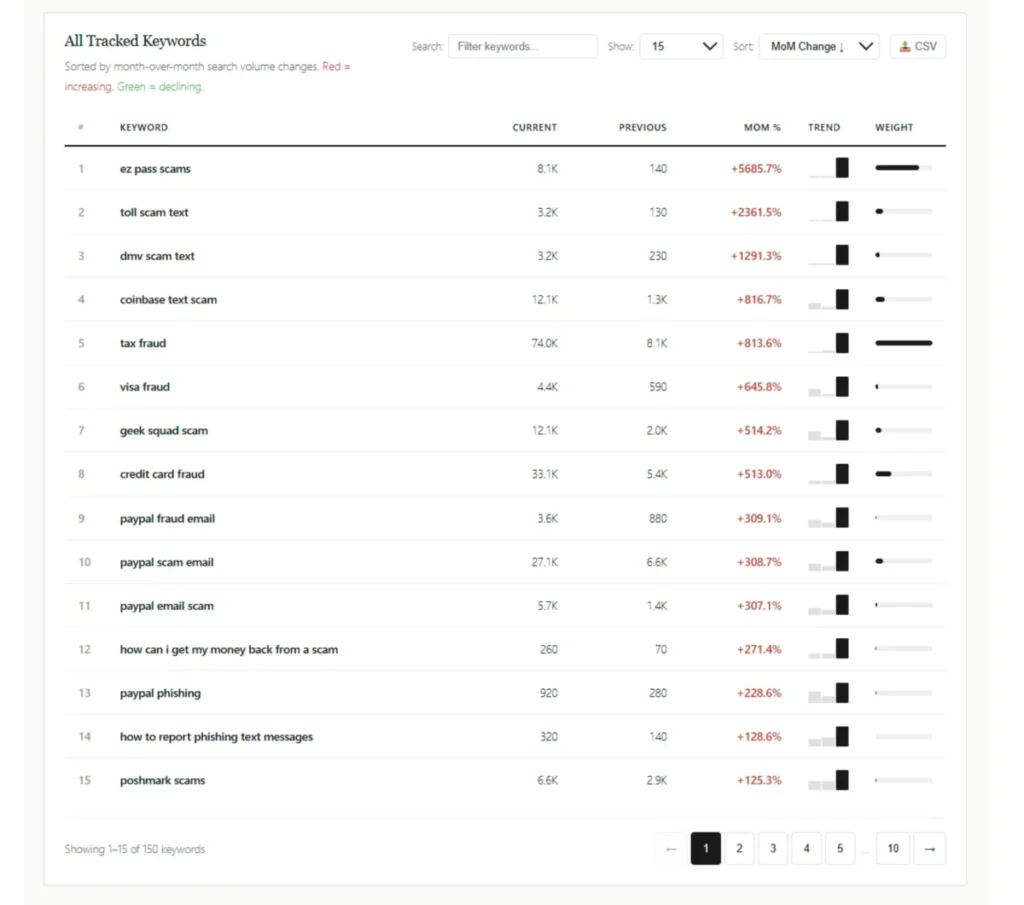
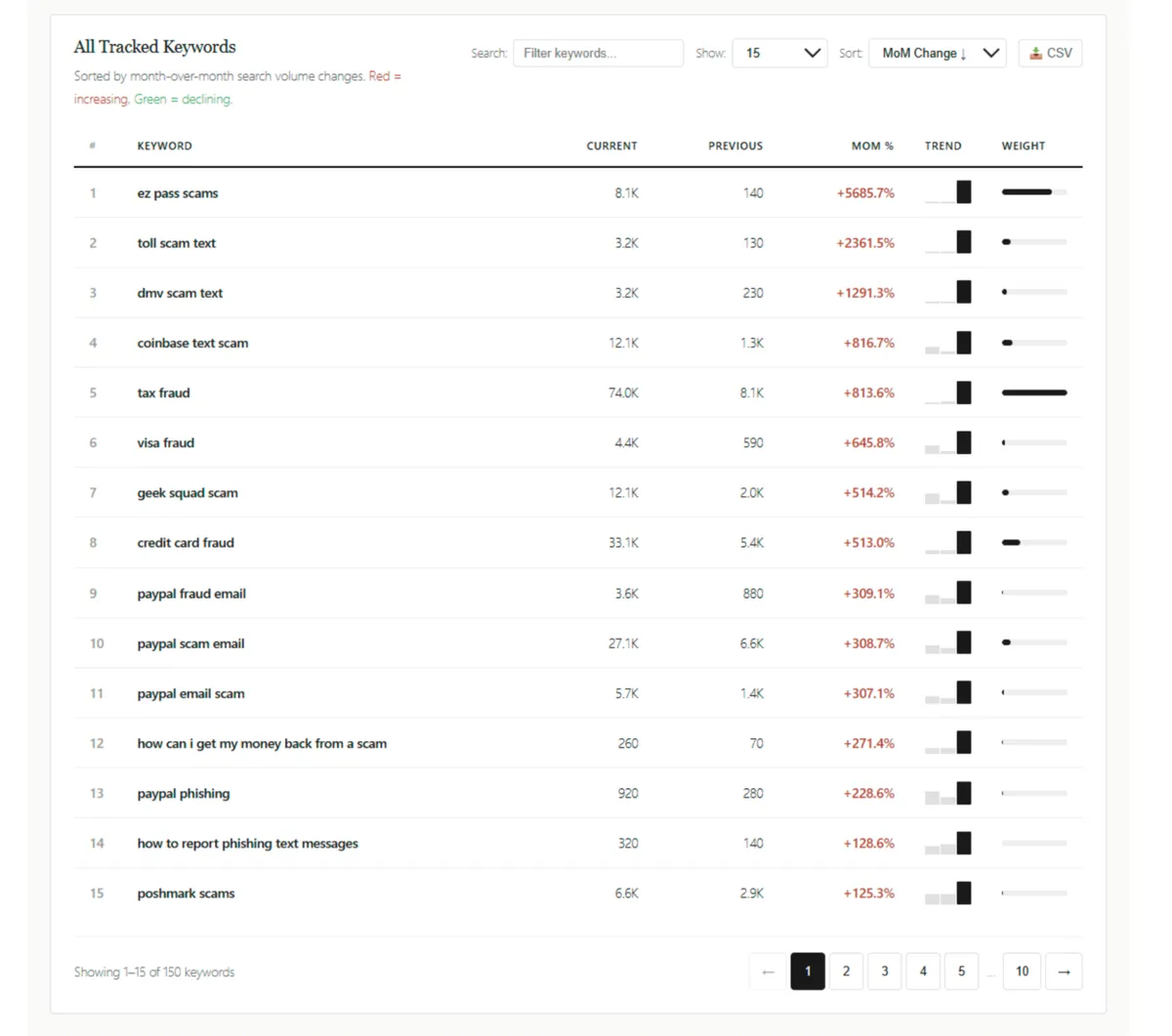
Civoryx tracks unusually sharp MoM growth. Consider these recent spikes:
- EZ Pass scams: +5,685%
- Toll scam text: +2,361%
- DMV scam text: +1,291%
- Tax fraud: +814%
Notice a pattern? The fastest-growing terms (EZ Pass, Toll, DMV) are almost exclusively SMS-driven impersonation (Smishing).
When you see multiple unrelated industries (transportation, government, fintech) all experiencing 1,000%+ growth in text-based scam searches, it signals a systemic channel shift. For a business, this is the signal to reassess your customer-communication controls. If you usually send notifications via SMS, your customers are currently at their highest risk of falling for a “look-alike” text.
Step 3: Spotting the “Narrative-Driven” Cycle
One of the most sophisticated ways to use Civoryx is to look at what is falling alongside what is rising.
Recent data shows a fascinating divergence:
- Specific scams (EZ Pass, Tax) are skyrocketing.
- Generic queries are plummeting: “Is this a scam” (-55%), “Phishing” (-18%), and “Gift card scam” (-46%).
When generic awareness queries fall while specific scam types rise, it indicates a narrative-driven fraud cycle. Fraudsters have found a “hook” that is so convincing (like a fake toll road bill) that users don’t even stop to ask, “Is this a scam?” They go straight to searching for the specific entity involved.
If you see this divergence, it means your traditional “general awareness” training for employees or customers might fail. You need to pivot your messaging from “How to spot a scam” to “We will never text you about a toll payment.”
Step 4: Applying Civoryx to Your Specific Sector
The Civoryx index categorizes intent, allowing you to filter the signal based on your industry’s risk profile.
| Category Driver | Contribution Score | Industry Application |
| Tax-Related Fraud | ~75.7 | Accounting, Payroll, Government, Banking |
| Payments & Financial | ~56.0 | E-commerce, Fintech, Credit Unions |
| Messaging Vectors (SMS/Email) | ~15.6 | Telecom, IT Security, SaaS |
| Phishing (Generic) | ~4.0 | General Corporate Compliance |
For Fintech and Banking
The high contribution of “Coinbase text scams” (12.43) and “Visa fraud” (3.57) suggests that the current trend is targeting liquidity and immediate asset transfer. If you are in this sector, you should be lowering the “alert threshold” for high-velocity outbound transfers during these periods.
For Logistics and Infrastructure
The 5,000%+ growth in EZ Pass and Toll scams is a direct threat to trust in digital infrastructure. If you manage a toll system or a delivery service, this is a signal to launch a preemptive “Stay Vigilant” campaign via your official app to “poison the well” for the scammers.
A Note on Data Limitations: The “Internet Penetration” Gap
While Civoryx is a powerful tool for global trends, it is important to apply a layer of critical thinking to the geography.
Civoryx data may underrepresent fraud trends in regions with low internet penetration.
Because the Scam Trend Score relies on search volume, it is most accurate for “Digital First” economies. If your industry operates heavily in emerging markets where fraud might be conducted via localized offline social engineering or USSD codes rather than web searches, the Civoryx score should be treated as a secondary signal rather than a primary one.
However, in the West and high-penetration Asian markets, it remains the gold standard for real-time visibility.
How to Integrate Civoryx into Your Workflow
You don’t need a budget or a complex API integration to start using this data. Civoryx is free and public.
- Weekly Check-in: Review the Scam Trend Score every Monday morning. Is the overall “temperature” of fraud rising or falling?
- The “Top 5” Audit: Look at the top 5 contributors to the score. Does your company use any of these names (e.g., PayPal, Visa, SMS) in its customer interactions?
- Threshold Adjustments: If you see a +1,000% spike in a specific vector (like SMS), notify your SOC (Security Operations Center) to tighten filters on incoming/outgoing communication patterns that match that narrative.
- Content Creation: Use the rising keywords to fuel your customer newsletter. Warning customers about a “Toll Scam” when searches for it are up 2,000% makes your brand look proactive and protective.
30-Day Fraud Intelligence Monitoring Roadmap
| Week / Phase | Day | Strategic Action | Primary Objective |
| Week 1: The Baseline | Mon | Check Scam Trend Score | Gauge if global fraud “heat” is rising or falling. |
| Tue | Identify Top 5 Contributors | Pinpoint the heavy hitters (e.g., Tax Fraud at 75.74). | |
| Wed | Internal Mapping | Match Civoryx keywords to your specific business vectors. | |
| Thu | Analyze “Declining Attention” | Identify if generic phishing is falling while specific narratives rise. | |
| Fri | Leadership Briefing | Send a high-level summary of the month’s primary threats. | |
| Week 2: Velocity Scan | Mon | Sort by Growth % | Find “Sleeping Giants” (e.g., EZ Pass scams at +5,685%). |
| Tue | Communication Audit | Review SMS/Email templates for smishing vulnerabilities. | |
| Wed | “Poison the Well” | Issue proactive customer warnings based on rising trends. | |
| Thu | IT/Security Sync | Share messaging vector data (~15.6) to justify filter tweaks. | |
| Fri | Update Fraud Dictionary | Equip support teams with the latest high-velocity keywords. | |
| Week 3: Tactical Hardening | Mon | Financial Category Deep-Dive | Analyze the ~56.0 contribution from payments/wallets. |
| Tue | Platform Specifics | Look for crypto/fintech spikes (e.g., Coinbase at +817%). | |
| Wed | Threshold Adjustment | Lower “Manual Review” triggers for high-risk narratives. | |
| Thu | Queue Review | Check if current “live” fraud matches Civoryx data. | |
| Fri | Scenario Testing | Run a tabletop exercise on a high-growth scam narrative. | |
| Week 4: Review & Refine | Mon | Data Correlation | Compare internal incidents vs. Civoryx search peaks. |
| Tue | Lead Time Calculation | Determine how much “warning” the index provided. | |
| Wed | Regional Adjustment | Account for low internet penetration gaps in emerging markets. | |
| Thu | Monthly Risk Report | Use the “No Opinions” data to justify security ROI. | |
| Fri | The Reset | Clear the board and prepare for the next monthly score. |
Implementation notes for compliance teams:
- The “Internet Penetration” Filter: When reviewing the table in Week 4, remember that Civoryx data is search-based. If your customers are in regions with lower web usage, treat the “Smishing” trends as a probability rather than a certainty, as those users may be targeted via offline methods not captured by search volume.
- The “Narrative” Trap: Pay close attention to Week 1, Thursday. If you see specific scams rising while “Is this a scam” queries fall (-55%), it means the fraudsters’ story is currently very believable. Your table actions for Week 2, Wednesday (Customer Warning) become your most important task of the month.
You can easily copy the table into a shared project management tool (like Trello, Asana, or Jira) to assign specific days to different analysts. Because Civoryx is permanently free, there’s no barrier to giving every member of your SOC (Security Operations Center) access to the raw index.
Summary
The old way of handling fraud was waiting for the “incident report.” The Civoryx way is watching the “intent signal.”
By monitoring the 150+ keywords and the resulting Scam Trend Score, you gain a 2–4 week window of visibility that the news cycle simply cannot provide. Whether it’s a seasonal tax spike or a sudden shift toward SMS-based impersonation, the data is there—transparent, unopinionated, and free.