Global Fraud Index for Business Owners: Is This Scam Trend Dashboard Worth Your Time?
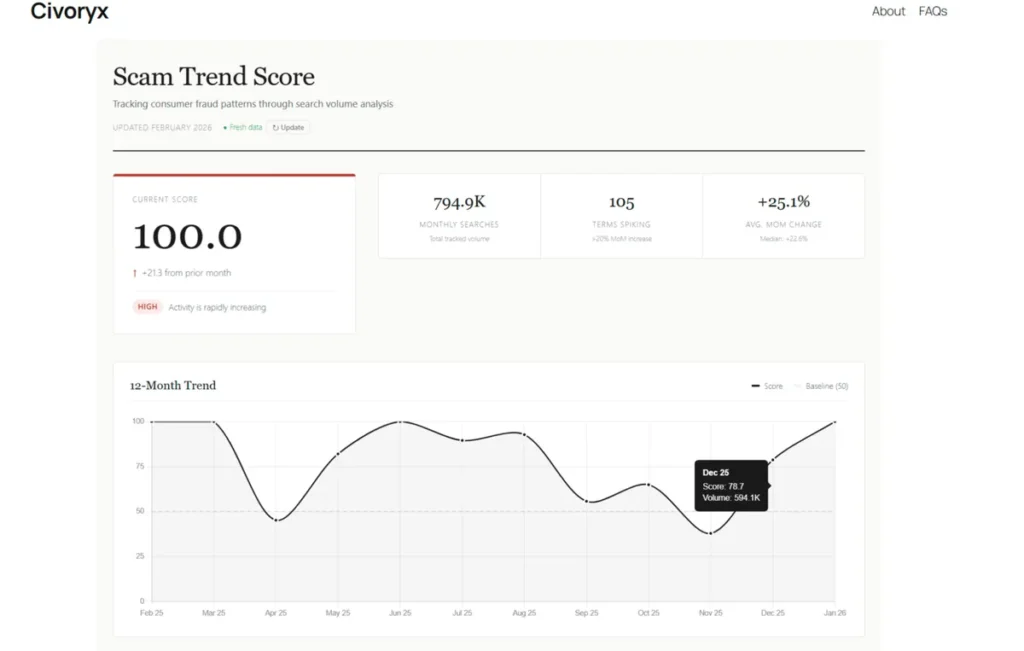
In the quiet, humming corridors of the modern digital economy, there is a predator that never sleeps, never tires, and—most importantly—never stops evolving. For the business owner, fraud isn’t just a line item under “loss prevention”; it’s a shape-shifting ghost that haunts every transaction, every SMS notification, and every “urgent” email from the CEO.
Traditionally, we’ve fought this ghost with history books. We wait for a major news outlet to report on a “new” scam, we read the post-mortem, and we adjust our defenses. But there’s a fatal flaw in that strategy: by the time a scam is a headline, it’s already a memory for the scammers who have moved on to the next kill.
Enter Civoryx, the “Global Fraud Index.” It promises a real-time, data-only lens into the world of deception. But for a business owner whose time is more valuable than gold, the question remains: Is the Scam Trend Score a vital early-warning system, or just more digital noise?
In this deep-dive review, we’re going to dissect the methodology, analyze the startling data from February 2026, and determine if this dashboard deserves a permanent tab in your browser.
The Philosophy of the “Zero-Speculation” Signal
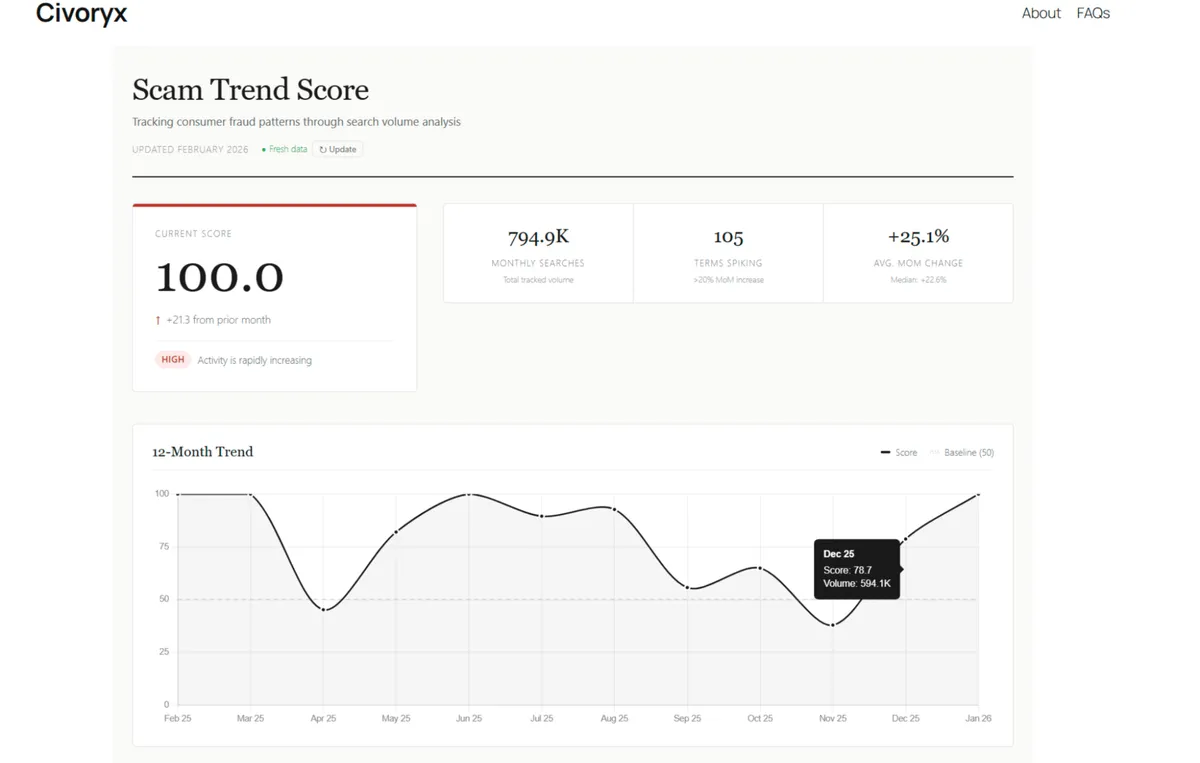
Civoryx operates on a refreshingly cold premise. It doesn’t care about expert opinions, “thought leadership” whitepapers, or the speculative ramblings of cybersecurity pundits. It cares about search volume.
The logic is elegant in its simplicity: When people are targeted by something suspicious, their first instinct is to ask the internet for help. They type “EZ Pass text scam” or “IRS tax fraud call” into a search bar. By aggregating these whispers from across the globe, Civoryx creates a composite signal.
Why It Exists: Solving the “Headline Lag”
Fraud moves at the speed of fiber optics; news moves at the speed of editorial calendars. Civoryx was built to bridge this “Headline Lag.” It focuses on velocity—how fast a specific scam is spreading right now—giving researchers, journalists, and business owners a way to see the wave before it crashes on their shore.
Scammers are agile. They launch a campaign, reap the rewards, and disappear before the first journalist has even finished their morning coffee. Civoryx is designed to catch that initial spike of search interest—the “canary in the coal mine”—before the damage becomes widespread.
Under the Hood: The Three-Layer Architecture
To understand if the score is reliable, we have to look at the machinery. Civoryx doesn’t just count searches; it weights them. This is where the platform moves from a simple tool to a sophisticated index.
1. Monitor: The Broad Net
The engine tracks 150 fraud-related keywords. This isn’t a static list; it’s a living index that spans the entire ecosystem of modern deceit:
- Infrastructure Scams: EZ Pass, DMV, Tolls, Utilities.
- Financial Scams: Credit cards, PayPal, Visa, Wire transfers.
- Crypto Scams: Coinbase, MetaMask, Wallet drains, “Pig butchering.”
- Social Engineering: Geek Squad, McAfee renewals, “Help Desk” calls.
- Generic Sentiment: “Is this a scam?”, “Phishing,” “Scam reporting.”
2. Measure: The Velocity Metric
The system calculates the month-over-month (MoM) change for every keyword. This is the “speed” of the fraud. If a term spikes by 5,000% in 30 days, something is happening in the real world. Civoryx captures the acceleration of intent.
3. Score: The Weighted Signal
This is the most critical part. Civoryx weights these changes by absolute search volume. For example:
- Case A: A niche scam goes from 10 searches to 100 searches. That’s a +900% growth, but it’s “noise.”
- Case B: A massive scam like “Tax Fraud” goes from 100,000 to 200,000 searches. That’s a +100% growth, but it’s a “major signal.”
The Scam Trend Score is the weighted aggregate of these signals. A rising score means the global “heat” of fraud is increasing. A falling score means the current waves are receding.
The February 2026 Data: A Masterclass in Seasonal Deception
To see if this tool is worth your time, we have to look at the data it’s currently spitting out. The February 2026 report is a stark reminder that scammers are, if nothing else, incredibly disciplined about their “seasonal offerings.”
The Top Contributors (The “Heavy Hitters”)
The weighted impact shows us where the most victims are currently being “touched.”
| Keyword | Weighted Contribution | The Narrative |
| Tax Fraud | 75.74 | The apex predator of February. |
| EZ Pass Scams | 57.94 | Massive infrastructure-based phishing. |
| Credit Card Fraud | 21.36 | The evergreen baseline of theft. |
| Coinbase Text Scam | 12.43 | Targeted crypto-asset drainage. |
| PayPal Scam Email | 10.53 | Classic payment platform impersonation. |
From a compliance perspective, this concentration indicates that seasonal financial fraud and impersonation campaigns are currently the dominant forces in the global fraud landscape. For a business owner, this table is essentially a “Threat Priority List.”
The “Velocity” Spikes: Where the Fire is Spreading
While “Tax Fraud” has the biggest impact, the growth numbers tell us where the new fires are being lit. The February data shows a terrifying shift toward SMS-driven infrastructure scams:
- EZ Pass Scams: +5,685%
- Toll Scam Text: +2,361%
- DMV Scam Text: +1,291%
- Coinbase Text Scam: +817%
- Tax Fraud: +814%
- Visa Fraud: +646%
- Geek Squad Scam: +514%
- Credit Card Fraud: +513%
The Analysis: We are witnessing a global pivot toward “Smishing” (SMS Phishing). Scammers are moving away from the crowded inbox—where corporate filters are increasingly effective—and moving onto the personal, immediate screen of the mobile phone.
The massive spikes in “EZ Pass” and “Toll” scams suggest a coordinated campaign targeting commuters. These are “low-friction” scams; a victim receives a text about a $5.00 unpaid toll, clicks the link to “resolve” it, and hands over their credit card details without thinking twice. For an employee using a company phone or a corporate card, this is a massive vulnerability.
The “Invisible” Caveat: The Digital Blind Spot
While the Civoryx data is compelling, we must address a fundamental limitation of any tool based on digital footprints.
Critical Note: Civoryx data may underrepresent fraud trends in regions with low internet penetration.
This is the “Unique Fact” that every global business owner must internalize. Because the index relies on search engine data, it is a reflection of the “Connected World”:
- In highly digital societies (North America, Europe, East Asia), people search when they are confused. The data is rich and accurate.
- In regions where internet access is a luxury or where fraud is conducted via face-to-face interactions or traditional telephony without a “verification” culture, Civoryx will be largely silent.
If your business has a supply chain or physical operations in rural areas of the Global South, a “Low” Scam Trend Score on Civoryx does not mean your employees are safe; it simply means their struggle isn’t being indexed by a search engine. You must supplement this dashboard with local intelligence in those markets.
Is It Worth Your Time? The Business Owner’s Verdict
Most “threat intelligence” platforms come with a five-figure price tag and a 50-page onboarding manual. Civoryx offers a different value proposition.
The Pricing Model: Radical Transparency
Civoryx is free, fully, permanently:
- No account required: No email collection, no marketing funnels.
- No “Premium” tiers: The data isn’t throttled.
- Public Access: It’s a public utility for fraud transparency.
For a small-to-medium business (SMB) owner who doesn’t have a $500k security budget, this is a game-changer. It provides “Enterprise-Grade” situational awareness for the cost of zero dollars.
The Strategy: How to Weaponize the Data
Don’t just look at the numbers—act on them. Here is how a savvy business owner should use the Civoryx dashboard:
- The Monday Morning Pulse: Spend 3 minutes every Monday morning looking at the “Fastest Growing” themes. This is your weekly “weather report.”
- The “Teachable Moment” Memo: If “Tax Fraud” is contributing 75.74 to the index, send a brief message to your finance and HR teams: “Heads up, Civoryx shows tax-related scams are peaking globally this week. Be extra vigilant with any W-2 requests or unexpected tax authority emails.”
- Audit Your Tech Stack: If you see a spike in “Coinbase Text Scams” (+817%) and your company holds crypto assets, it’s time to double-check your 2FA settings and remind stakeholders never to click links in SMS notifications.
- Customer Communication: If you see a spike in scams impersonating your industry (e.g., “Visa Fraud” +646%), use your social media or newsletter to warn your customers. “We’re seeing a global rise in payment impersonation scams. Remember, we will never ask for your card details via text.” You aren’t just protecting your business; you’re building trust with your audience.
The “Cooling” Trends: What Scammers are Abandoning
One of the most useful features of Civoryx is seeing what isn’t working. In February 2026, searches for generic or “outdated” terms fell significantly:
- “Is this a scam” (-55%)
- Gift card scams (-46%)
- McAfee scams (-45%)
- Phishing (-18%)
What this tells us: The public is becoming “niche-aware.” They aren’t searching for the concept of phishing anymore; they are searching for the specific brand being used against them (e.g., “EZ Pass scam”).
The drop in “Gift card scams” suggests that this particular vector—a favorite for years—might be losing its effectiveness as retailers and consumers become more educated. This allows you to shift your focus away from “yesterday’s news” and toward the “Smishing” and “Infrastructure” threats that are currently accelerating.
A Detailed Look at the “Smishing” Explosion
The February 2026 data isn’t just a collection of numbers; it’s a warning of a paradigm shift. Let’s look at the “Infrastucture + SMS” cluster:
- EZ Pass: +5,685%
- Toll Scam: +2,361%
- DMV Scam: +1,291%
Why is this happening now? 3 reasons:
- High Frequency, Low Friction: Everyone drives. Everyone pays tolls. These scams target a universal activity, making the “pool” of potential victims massive.
- The Authority Lure: These scams impersonate government or semi-government agencies (DMV, Toll authorities). People are conditioned to respond to “official” notices regarding licenses or fines.
- Channel Trust: We still trust SMS more than email. While our email inboxes are 90% spam, our text messages are still largely personal. Scammers are exploiting that intimacy.
For a business owner, this means your “Bring Your Own Device” (BYOD) policy is now a primary attack vector. If an employee clicks a “Toll Scam” link on their phone—which is also logged into the company’s Slack and email—the ghost in the machine has found its way in.
Conclusion: A Signal Through the Static
Civoryx is not a “magic bullet.” It won’t stop a hacker from attempting to breach your server, and it won’t catch every local scammer in a low-connectivity region. It is a macro tool for a micro world.
However, in a landscape where we are drowning in information but starving for wisdom, Civoryx provides a clear, data-driven signal. It turns the chaotic, terrifying world of global fraud into a series of predictable waves that you can see coming from miles away.
The Verdict: Is the Scam Trend Dashboard worth your time? Absolutely. For the cost of a bookmark in your browser, Civoryx is one of the highest-ROI tools a business owner can possess in 2026. It is the “Weather App” for the digital storm. You check the weather before you leave the house to know if you need an umbrella; you check Civoryx to know if your business needs to tighten its defenses.
In the fight against fraud, transparency is the only weapon that truly scales. Civoryx has democratized that weapon. Use it.
FAQ
1. What exactly is the Civoryx Scam Trend Score?
The Scam Trend Score is a composite, data-driven metric that measures the global “velocity” of fraud. Instead of relying on anecdotal reports or news cycles, it aggregates real-time search volume changes across 150+ fraud-related keywords. When the score rises, it indicates that more people globally are encountering and searching for information on active scams.
2. How does Civoryx find its data?
Civoryx monitors a curated index of search terms across major search engines. By tracking what potential victims are searching for in their moments of suspicion (e.g., “is this text from the DMV a scam?”), the platform captures the “demand side” of the fraud ecosystem.
3. Why is search volume a better metric than traditional news reporting?
Traditional reporting suffers from “Headline Lag.” By the time a scam is investigated and published by a news outlet, the peak of the attack has often already passed. Search volume is a leading indicator; it spikes the moment a coordinated campaign hits the public’s devices, often days or weeks before it hits the evening news.
4. What does “weighted by volume” mean in the scoring process?
Not all search spikes are equal. If a niche scam goes from 5 searches to 50, that is a 900% increase but represents very little real-world impact. Civoryx weights keywords by their absolute search volume. This ensures that a 20% spike in a massive category like “Credit Card Fraud” carries more weight than a 5,000% spike in a tiny, obscure category.
5. Is Civoryx really free? What’s the catch?
Yes, it is fully and permanently free. There are no “Premium” tiers, no gated data, and no account requirements. The creators believe that fraud transparency is a public good and that the data should be open because the problem of cybercrime is universal.
6. How often is the data updated?
The index is updated regularly to reflect the most current month-over-month (MoM) trends. This allows business owners to perform “weekly pulse checks” to see which threats are accelerating in real-time.
7. What are the “Top Contributors” mentioned in the February 2026 data?
Top contributors are the specific keywords that are currently exerting the most influence on the overall Scam Trend Score. For example, in February 2026, Tax Fraud and EZ Pass Scams were the primary drivers of global fraud attention, accounting for the largest portion of the weighted index.
8. Why are “EZ Pass” and “Toll” scams growing so fast right now?
These are part of a massive shift toward SMS-driven infrastructure impersonation. Scammers target universal daily activities (like driving or paying tolls) because the “hit rate” is high. In February 2026, EZ Pass scams saw an astronomical growth of over 5,600%, indicating a highly coordinated global botnet campaign.
9. Can I use Civoryx data for my company’s security training?
Absolutely. In fact, that is one of its best use cases. Rather than giving employees generic “don’t click links” advice, you can use Civoryx to provide specific, timely warnings. For example: “This week, we are seeing an 800% increase in Coinbase-related SMS scams. Please be extra vigilant if you receive a text regarding your crypto accounts.”
10. Does a “Falling Score” mean fraud is going away?
Not necessarily. A falling score means that search interest is cooling compared to the previous period. This could mean a major campaign has ended, or that the public has become sufficiently educated about a specific scam type that they no longer need to search for it.
11. What is the “Digital Blind Spot” mentioned in the review?
Civoryx relies on internet search data. Therefore, it may underrepresent fraud trends in regions with low internet penetration or in areas where fraud is conducted via offline methods (like physical mail or in-person “distraction” scams). It is a reflection of the “Connected World” and should be supplemented with local intelligence in less-connected markets.
12. Why did generic terms like “phishing” and “is this a scam” decline in February 2026?
This suggests a shift in public sophistication. Users are becoming “brand-aware.” Instead of searching for the broad concept of a scam, they are searching for the specific entity being impersonated (e.g., “Geek Squad scam”). This means scammers are finding more success with highly specific, branded lures.
13. Does Civoryx track crypto-specific fraud?
Yes. The index includes keywords for major exchanges (like Coinbase), wallet types, and generic terms like “crypto scam” or “wallet drainer.” In early 2026, crypto-related SMS scams have been a significant contributor to the global score.
14. How should a business owner incorporate this into their routine?
A simple 3-minute “Monday Morning Check” is usually sufficient. Look at the “Fastest-Growing Scam Themes” to see if any of them overlap with your industry or the tools your employees use. Use that data to send a quick, high-impact internal alert if necessary.
15. Does Civoryx provide personal protection or antivirus software?
No. Civoryx is an information index, not a security tool. It provides the situational awareness you need to know where to point your existing security resources. It tells you what the “weather” is so you know when to carry an umbrella.