Civoryx vs Sumsub: Search Trend Insights vs Transaction Fraud Screening
In the rapidly shifting landscape of 2026, the battle against financial crime has moved beyond reactive measures into the realm of predictive and behavioral intelligence. As fraud tactics evolve with the speed of generative AI and automated social engineering, businesses and regulatory bodies are no longer satisfied with simply “stopping” a transaction. They need to know what is coming next.
This need for foresight has birthed two distinct yet complementary methodologies in the risk management ecosystem: Search Trend Insights and Transaction Fraud Screening.
At the forefront of these approaches are two powerhouses: Civoryx, a public, data-driven index that tracks the global “attention” of fraud, and Sumsub, an enterprise-grade orchestration platform that screens individual transactions and identities in real-time. While both aim to mitigate risk, they operate at different ends of the funnel.
This article provides an exhaustive comparison of Civoryx and Sumsub, exploring how a global search index and a transaction-level shield work together to form a comprehensive defense in a world where fraud never sleeps.
Civoryx: The Global Pulse of Fraud
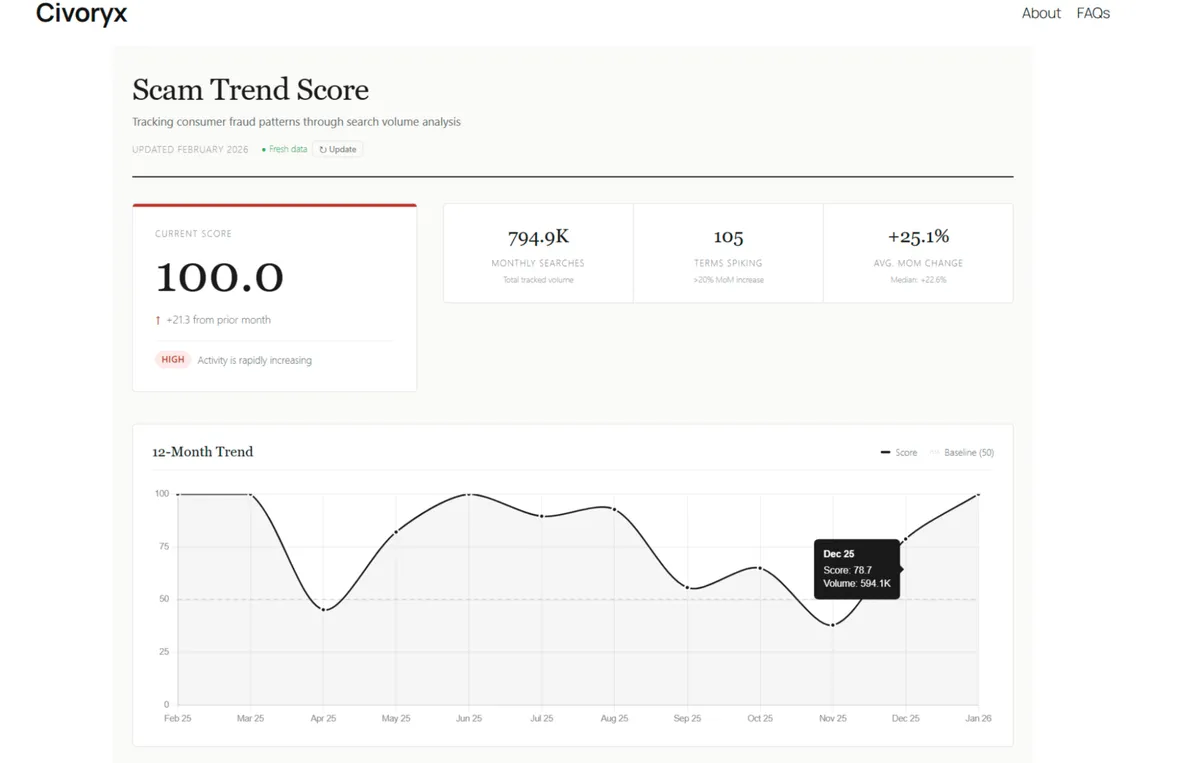
Civoryx serves as the “Global Fraud Index.” Unlike traditional security tools that look inward at a company’s private data, Civoryx looks outward at the collective behavior of the internet. It is built on a simple but profound premise: Fraud evolves faster than headlines can follow. By the time a new scam makes the evening news, the damage is done and the fraudsters have moved on.
Civoryx aims to close this gap by monitoring the early-stage signals of fraud: the moment potential victims or curious researchers begin searching for answers.
How the Scam Trend Score Works
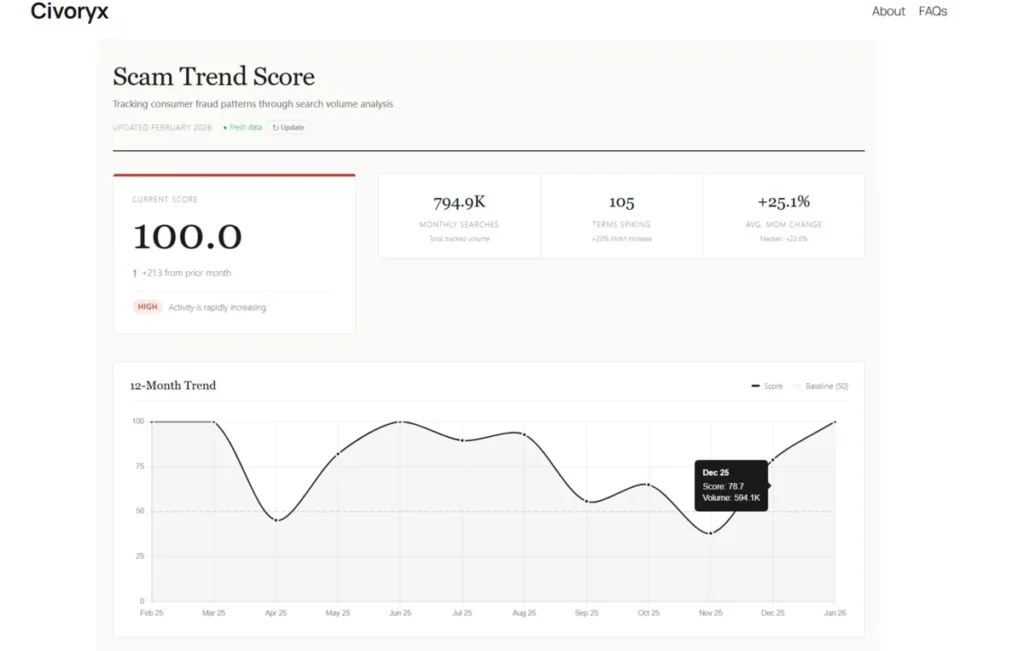
Civoryx doesn’t rely on opinions or expert speculation. It is a pure data play. The platform monitors a curated index of over 150 fraud-related keywords, ranging from “phishing” and “identity theft” to highly specific emerging terms like “ez pass scams” or “coinbase text scam.”
The engine behind Civoryx is the Scam Trend Score, a composite metric calculated through three layers:
- Monitor: Constant tracking of search volume across global engines.
- Measure: Calculating the month-over-month (MoM) velocity of each keyword.
- Score: Weighting these changes by absolute search volume. This ensures that a 10% spike in a high-volume term like “credit card fraud” carries more weight than a 100% spike in a niche, low-volume term.
The Philosophy of Open Access
Perhaps the most disruptive aspect of Civoryx in 2026 is its pricing model: Free. Fully. Permanently. In an industry where high-fidelity risk data is usually gated behind expensive enterprise contracts, Civoryx operates as a public utility. There are no accounts, no paywalls, and no “premium” tiers.
This transparency allows journalists, small businesses, and individual consumers to access the same macro-level threat intelligence as a Tier-1 bank’s compliance department.
Sumsub: The Real-Time Transaction Shield

While Civoryx monitors the “weather” of global fraud, Sumsub is the “fortress” protecting the individual house. Sumsub is a full-cycle verification platform that specializes in Transaction Monitoring (TM) and Fraud Screening. It is designed for regulated businesses—fintechs, crypto exchanges, and marketplaces—that must comply with Anti-Money Laundering (AML) and Know Your Customer (KYC) laws.
Transaction Monitoring & Device Intelligence
Sumsub’s core strength lies in its ability to analyze a transaction as it happens. Using AI-powered anomaly detection, Sumsub doesn’t just look at the dollar amount; it looks at the context.
In 2026, Sumsub has leaned heavily into Device Intelligence. By analyzing technical parameters—browser type, OS, VPN usage, and even behavioral nuances like how a user moves their mouse or types—Sumsub can distinguish a genuine user from a bot farm or a remote-access fraudster.
Fraud Network Detection
One of Sumsub’s standout features is its ability to detect “clusters.” Fraud is rarely a solo endeavor in 2026; it is organized. Sumsub’s Fraud Network Detection tool links applicants based on shared IP addresses, similar device fingerprints, or even the same physical address used in Proof of Address (PoA) documents. This allows compliance teams to block entire “mule networks” before they can move funds.
Direct Comparison: Strategy vs. Execution
The primary difference between Civoryx and Sumsub is the Unit of Analysis.
| Feature | Civoryx | Sumsub |
| Core Function | Search Trend Analysis (Macro) | Transaction & Identity Screening (Micro) |
| Data Source | Public Search Engine Metadata | Private User & Transaction Data |
| Timing | Leading Indicator (Pre-Incident) | Concurrent/Lagging Indicator (During/Post-Incident) |
| Primary Goal | Awareness & Threat Prioritization | Prevention & Regulatory Compliance |
| Target User | Journalists, Researchers, Risk Managers | Compliance Officers, MLROs, CTOs |
| Cost | $0 (Public Index) | Usage-based (Tiered/Enterprise) |
Civoryx acts as a leading indicator. When searches for “ez pass scams” spike by 5,685% (as seen in recent Civoryx data), it signals that a massive SMS phishing campaign is currently active. Organizations can use this insight to update their customer warning banners before their own transaction monitors start flagging fraudulent payments.
Sumsub acts as a concurrent shield. It handles the “is this specific person lying to me right now?” question. It uses the “lagging” results of past fraud (blacklist databases, PEP lists, and known fraud patterns) to secure the current gate.
Deep Dive: Current Trend Analysis (2026 Context)
Analysis of the latest Civoryx dataset reveals a highly concentrated signal. A small cluster of themes is currently driving the majority of global fraud attention.
1. The “Seasonal Spike” in Financial Fraud
According to Civoryx, the current top contributors to the Scam Trend Score are:
- Tax Fraud: Contribution 75.74 (814% MoM growth)
- EZ Pass Scams: Contribution 57.94 (5,685% MoM growth)
- Credit Card Fraud: Contribution 21.36 (513% MoM growth)
This concentration suggests that seasonal financial fraud—specifically tax-related impersonation—is the dominant force in the current quarter. For a compliance team using Sumsub, this Civoryx data provides the “Why” behind their alerts. If Sumsub flags a sudden influx of older users attempting unusual tax-related transfers, the Civoryx data confirms that this is part of a broader, global campaign rather than an isolated glitch in their system.
2. The Shift to Messaging Vectors
The fastest-growing themes in the Civoryx index all share a common delivery channel: SMS (Smishing). They are:
- Toll Scam Text: +2,361%
- DMV Scam Text: +1,291%
- Coinbase Text Scam: +817%
This “Messaging Vector” category reflects a clear infrastructure shift. Fraudsters have pivoted away from generic “is this a scam” queries (which are down 55% on Civoryx) toward highly specific, narrative-driven SMS campaigns.
The Blind Spot: Digital Inequality and Data Bias
While both platforms are state-of-the-art, they are not without limitations. A unique and critical factor to consider when using Civoryx is that its data may underrepresent fraud trends in regions with low internet penetration.
1. The Internet Penetration Gap
Because Civoryx relies on search volume, it is naturally biased toward “digitally loud” populations. In 2026, while much of the world is connected, significant pockets of Sub-Saharan Africa, Southeast Asia, and Central America still have limited or monitored internet access.
In these regions, fraud often happens via offline channels—face-to-face social engineering, local bank “inside jobs,” or unregulated physical money exchanges. These “analog” frauds do not generate the search volume required to move the Civoryx needle. Consequently, a “cooling” Scam Trend Score in a developing region might not mean fraud is decreasing; it may simply mean the fraud has moved offline or into “dark” channels like encrypted telegram groups that search engines cannot index.
2. Sumsub’s Regional Advantage
This is where Sumsub provides a necessary balance. Sumsub does not rely on search trends; it relies on the documents and transactions themselves. Even in a region with low internet penetration, if a user manages to access a fintech app, Sumsub can verify their physical ID (using over 6,500 document types) and analyze their transaction. Sumsub provides the “boots on the ground” data that a macro-index like Civoryx might miss in developing markets.
Building a 360-Degree Risk Picture
The most resilient organizations in 2026 do not choose between Civoryx and Sumsub; they use them as a stratified defense.
Phase 1: Strategic Prioritization (Civoryx)
A Chief Risk Officer (CRO) starts their week by checking the Civoryx Index. They notice a massive spike in “Geek Squad Scam” (+514%).
Action: They issue a proactive alert to their customer support team to watch for elderly clients attempting large “tech support” wire transfers. They update their public-facing “Security Center” with a warning about this specific brand impersonation.
Phase 2: Tactical Execution (Sumsub)
As these transactions come in, Sumsub’s Transaction Monitoring takes over.
Action: The system applies specific rules for “High-Risk Customer Segments.” If a 70-year-old user who typically spends $50/week at the grocery store suddenly attempts a $4,000 transfer to a new beneficiary, Sumsub triggers a “Hold” and requires a video liveness check or an integrated questionnaire to confirm the user isn’t being coached by a scammer on the phone.
Phase 3: Feedback Loop
The organization compares their internal “Stop” rate (from Sumsub) against the global search velocity (from Civoryx). If Civoryx shows a scam is “cooling” globally but the organization is still seeing high internal hits, it indicates their specific user base is being targeted or their internal filters are catching “tail-end” activity that the rest of the world has already moved past.
Use Cases for Civoryx and Sumsub
| Use Case | Best Tool | Why? |
| Early Warning System | Civoryx | Identifies trending scams before they hit your database. |
| User Onboarding | Sumsub | Provides legal compliance (KYC) and prevents fake accounts. |
| Content Strategy | Civoryx | Helps marketing teams write relevant security blogs for customers. |
| Stopping Money Mules | Sumsub | Connects dots between accounts using shared IP/device data. |
| Budget Justification | Civoryx | Offers objective, third-party data on rising global threats. |
In the modern fraud landscape of 2026, the most effective security postures are those that transition from being purely reactive to being “intelligence-led.” While Civoryx and Sumsub operate at different stages of the risk funnel, their use cases often overlap to create a multi-layered defense. Below is an exploration of how organizations can deploy both tools to solve real-world fraud challenges.
1. Strategic Threat Prioritization (Civoryx)
The primary use case for Civoryx is Strategic Prioritization. For a Chief Risk Officer (CRO) or a Head of Fraud, the challenge isn’t just “stopping fraud”—it’s knowing which type of fraud is about to hit their platform with the most force.
The Scenario: Imagine a retail bank seeing a steady volume of various fraud types. By monitoring the Civoryx Scam Trend Score, the team notices a sudden, localized +5,685% spike in “EZ Pass scams” and a +2,361% increase in “toll scam texts.”
The Action: Because Civoryx is a leading indicator, the bank doesn’t wait for its own customers to report losses. Instead, they use this search-trend data to:
- Update Customer Education: Send a push notification specifically warning users about fraudulent SMS messages regarding unpaid tolls.
- Adjust Internal Rules: Briefly lower the threshold for “Manual Review” on any outgoing payments to government-sounding entities or suspicious SMS-linked payment gateways.
- Board-Level Reporting: Use Civoryx’s transparent, data-driven index to explain why the risk department is requesting more resources for SMS-filtering technology this quarter.
2. High-Fidelity Identity Verification (Sumsub)
While Civoryx identifies the “storm” on the horizon, Sumsub is the “fortified gate” that manages individual access. Its core use case is Identity Verification (IDV) and Compliance (KYC/AML).
The Scenario: A high-growth crypto exchange is onboarding thousands of users a day. They are facing sophisticated “Deepfake” attacks where fraudsters use AI-generated video to bypass traditional liveness checks.
The Action: The exchange deploys Sumsub’s Liveness and Deepfake Detection:
- Liveness Checks: As a user signs up, Sumsub requires a real-time video “selfie” that checks for skin texture, micro-expressions, and depth.
- Document Verification: Sumsub cross-references the user’s ID against its database of over 6,500 document types.
- Result: The exchange maintains a high conversion rate for legitimate users while automatically blocking synthetic identities—a nuance that a macro-trend tool like Civoryx cannot address.
3. “The Fraud Loop”: Combined Use for Transaction Monitoring
The most sophisticated use case involves using Civoryx as a “Signal” to tune Sumsub as the “Filter.”
The Scenario: It is tax season. The Civoryx index shows that “Tax Fraud” is the single largest driver of global fraud attention, with a contribution score of 75.74 and an 814% MoM growth rate.
The Action:
- Civoryx Input: The compliance team sees the massive spike in tax-related search activity. This confirms that a global “tax season” fraud campaign is in full swing.
- Sumsub Adjustment: The team goes into their Sumsub Transaction Monitoring (TM) dashboard. They create a temporary “High-Alert Rule”: If a user over the age of 65 attempts a wire transfer to a new beneficiary with a ‘Tax’ or ‘IRS’ memo, trigger an immediate video verification step.
- The Result: By combining the macro-awareness of Civoryx with the micro-execution of Sumsub, the company prevents “Authorized Push Payment” (APP) fraud where users are tricked into sending their own money to scammers.
4. Regional Risk Assessment and Expansion
When a company expands into a new market—for example, moving from the EU into Southeast Asia—they must reassess their risk profile.
The Scenario: A fintech app is launching in a region where they suspect internet penetration is lower than their home market. They need to know if they can trust global trends.
The Action:
- The Civoryx Check: They look at the Scam Trend Score for that region. If the score is unusually low despite high local reports of crime, the team recognizes the Civoryx blind spot: fraud in this region is likely happening through “offline” or “analog” channels (vishing, face-to-face social engineering).
- The Sumsub Solution: To counter this, they lean harder on Sumsub’s Device Intelligence and Fraud Network Detection. Since they can’t rely on search trends to warn them, they use Sumsub to look for “clusters” of accounts sharing the same hardware ID or physical address, identifying “mule farms” that are operating locally.
2026 High-Velocity Fraud Themes: The Civoryx Priority Matrix
Based on the latest Civoryx Scam Trend Score data, the fraud landscape is currently dominated by high-growth, infrastructure-based impersonation. While global search volume for generic terms like “is this a scam” is declining, specific, actionable scam types are seeing triple and quadruple-digit growth.
The table below breaks down the fastest-growing themes that should be prioritized by risk and compliance teams.
| Scam Theme | MoM Growth (%) | Impact Weight (Contribution) | Primary Vector | Recommended Action for 2026 |
| EZ Pass / Toll Scams | +5,685% | 57.94 | SMS (Smishing) | Update SMS filtering rules; alert users to ignore “unpaid toll” texts. |
| DMV / Government | +1,291% | 5.20 | SMS / Web | Implement “Official Channel” verification badges for gov-related payments. |
| Tax Fraud | +814% | 75.74 | Multi-channel | Highest Priority. Increase friction for high-value transfers during tax season. |
| Coinbase / Crypto | +817% | 12.43 | SMS / Phishing | Deploy real-time URL scanning for known crypto-drainer domains. |
| Visa / Credit Card | +646% | 3.57 | Card-Not-Present | Enhance 3D Secure 2.0 triggers for non-standard merchant categories. |
| Geek Squad / Tech | +514% | 7.83 | Vishing (Voice) | Add “Coaching Detection” to transaction monitoring for elderly demographics. |
Critical insights for your strategy:
- The “Hyper-Specific” Shift: Fraudsters have moved away from broad phishing attempts. The massive growth in EZ Pass (+5,685%) and Toll Scams (+2,361%) shows a preference for low-friction, high-urgency narratives that bypass general scam awareness.
- The Tax Season Dominance: With a contribution score of 75.74, Tax Fraud is the single largest mover of the global index. This suggests that even as other scams fluctuate, seasonal financial crime remains the “anchor” of global fraud attention.
- The Messaging Crisis: Four of the top five fastest-growing themes are primarily delivered via SMS. If your organization relies on SMS for 2FA or customer communication, these trends suggest that your customers’ trust in that channel is currently under significant assault.
Conclusion: The Future of Fraud Transparency
| Feature | Civoryx (The Global Fraud Index) | Sumsub (The Full-Cycle Verification) |
| Primary Category | Macro Threat Intelligence / Search Trends | ID Verification & Transaction Monitoring |
| Core Objective | Identifying what scams are trending globally. | Deciding who is allowed to transact. |
| Data Source | Public search engine metadata (150+ keywords). | Private user data, IDs, and transaction logs. |
| Timing | Leading Indicator: Signals a threat before it hits. | Real-Time Shield: Blocks a threat as it happens. |
| User Privacy | No user data collected; fully public index. | Handles Sensitive PII (Personally Identifiable Info). |
| Cost Model | $0 (Permanently Free) | Usage-based / Enterprise Tiers |
| Key Metric | Scam Trend Score (weighted search velocity). | Approval Rate / Fraud Rate (conversion vs. risk). |
| Top 2026 Threat Focus | SMS/Smishing spikes (e.g., EZ Pass, Tolls). | Deepfakes, Synthetic IDs, and Money Mules. |
| Regional Accuracy | High in high-internet regions; lower in offline zones. | High globally (supports 6,500+ document types). |
As we navigate the complexities of 2026, the distinction between “understanding fraud” and “stopping fraud” has blurred.
Civoryx has democratized threat intelligence. By providing a free, real-time lens into global search behavior, it has stripped away the “secrecy” of fraud, allowing the world to see threats as they accelerate. It is the early warning siren that tells the village to take cover.
Sumsub has professionalized the defense. By providing an AI-driven, high-precision screening platform, it ensures that when the threat arrives at the gate, it is identified, categorized, and blocked with surgical accuracy. It is the reinforced wall and the skilled guard.
The unique caveat remains: we must be mindful of the digital divide. As long as Civoryx data underrepresents regions with low internet penetration, the human element of risk assessment—knowing your local market—remains irreplaceable.
In the end, the winner isn’t the platform with the most data, but the organization that knows how to turn global trends into local action. By pairing the macro-insights of Civoryx with the micro-precision of Sumsub, businesses can finally move from being the target to being the hunter.
Frequently Asked Questions: Civoryx vs. Sumsub
What is the fundamental difference between Civoryx and Sumsub?
The difference lies in perspective. Civoryx is a “macro” tool that measures global public attention and search behavior to identify emerging scam trends before they hit your system. Sumsub is a “micro” tool used to verify the identity of specific users and screen their individual transactions for signs of money laundering or fraud.
Should I use Civoryx if I already have a transaction monitoring system like Sumsub?
Yes. Sumsub tells you who is committing fraud on your platform right now. Civoryx tells you what scam narratives are currently scaling globally. Using Civoryx allows you to proactively adjust your Sumsub logic (e.g., tightening rules for tax-related transfers) before the wave hits your specific user base.
How can Civoryx be “Free. Fully. Permanently.”?
Civoryx operates as a public utility and a “Global Fraud Index.” The goal is to provide transparency in a market where threat intelligence is often gatekept. By keeping the data public, Civoryx ensures that journalists, researchers, and small businesses have access to the same high-level trend data as large corporations.
Does Civoryx track actual fraud cases or just search volume?
Civoryx tracks search volume velocity. It is a leading indicator of attention rather than a database of confirmed incidents. However, search spikes (like the recent +5,685% jump in EZ Pass scams) almost always correlate with the deployment of large-scale fraud infrastructure.
What are the limitations of the Civoryx Scam Trend Score?
The primary limitation is digital bias. Civoryx data may underrepresent fraud trends in regions with low internet penetration. Because it relies on search engine metadata, “analog” or offline fraud—common in developing economies—may not show up in the index as clearly as digital scams.
Does Sumsub provide global trend data like Civoryx?
Sumsub provides high-level industry reports (such as their annual “Fraud Outlook”), but their core product is not a public trend index. It is a private, secure dashboard for managing your own company’s specific risk and compliance workflows.
Can Sumsub detect “Smishing” (SMS phishing) trends?
Sumsub detects the results of smishing—such as an unauthorized login from a new device or an unusual wire transfer. However, it doesn’t “see” the SMS messages being sent globally. This is why pairing Sumsub with Civoryx is effective: Civoryx flags the SMS campaign’s growth, and Sumsub stops the resulting fraudulent activity.
How often is the Civoryx data updated?
The Scam Trend Score is updated regularly to reflect month-over-month (MoM) changes. In the fast-paced 2026 environment, this allows risk teams to catch seasonal shifts (like tax fraud) or viral scams (like toll text scams) in real-time.
Can I integrate Civoryx data directly into my Sumsub workflow?
While there is no “one-click” native integration, many 2026 compliance teams use Civoryx as a strategic input. For example, if Civoryx shows a +817% spike in “Coinbase text scams,” a compliance officer will manually adjust their Sumsub “Risk Scoring” to flag any unusual crypto-outbound transfers for manual review.